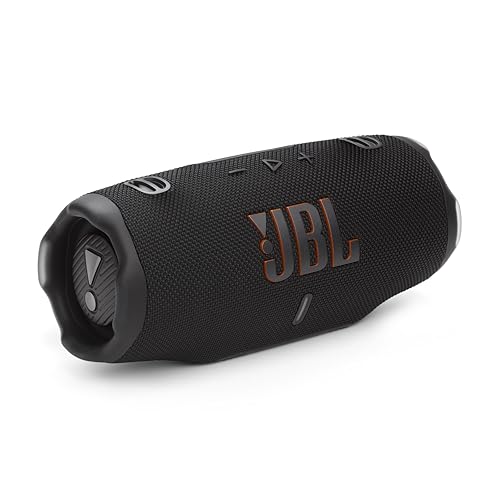
Every speaker lineup has a middle child that ends up in most backpacks. In ours, that is the JBL Charge 6. It is smaller than the Boombox 4, lighter than the Sonos Move 2 and a tier below the premium Bose, and it keeps most of what people want outdoors: a good battery, a rugged body and the ability to charge a phone. This profile goes through what JBL publishes about it and what SoundGuys reports, including a few things it does not do. We do not test products or take our own measurements. JBL announced the Charge 6 in March 2025.
What Is the JBL Charge 6?
The Charge 6 is a single-body Bluetooth speaker in JBL’s Charge line, which has long been built around a built-in power bank. On this site it sits in the mid-range tier, and we rank it third as a best-value all-rounder. The Amazon button at the end shows the current price, since we do not list prices. JBL lists output of 30 W RMS for the woofer and 15 W RMS for the tweeter. It also lists AI Sound Boost, which JBL says analyzes your music in real time, according to its product page.
Size and Weight
JBL’s spec table lists a net weight of 0.99 kg, or 2.18 lb, and a gross weight of 1.37 kg, which includes the packaging. Its dimensions are 22.9 x 9.9 x 9.4 cm, or about 9.0 x 3.9 x 3.7 inches. For comparison, the Boombox 4 weighs 13 lb according to JBL. At about 2 lb the Charge 6 fits in a daypack, a cooler bag or a bike basket without fuss. The removable handle strap that JBL includes can be used as a handle or, per SoundGuys, as a carrying loop.
Battery Life
JBL lists up to 28 hours of playtime and an extra 4 hours with JBL Playtime Boost. The two figures are worth reading together with SoundGuys’s report. SoundGuys quotes JBL at 24 hours at moderate volume with the standard EQ, and 28 hours with Playtime Boost, and says its standardized run at a fixed volume lasted 13 hours 15 minutes. That is a big gap. It shows how much the figure depends on volume, EQ and mode. For planning, treat the high numbers as best case, and expect a long day of play rather than a full weekend. SoundGuys also lists “Playtime Boost feature kills sound quality” as a con, so the extra hours cost you something.
Water, Dust and Drops
JBL lists an IP68 code. In IEC 60529 terms that is dust-tight and rated for continuous immersion under conditions set by the maker. SoundGuys says it can be submerged up to about 5 feet (1.5 meters) for 30 minutes. JBL’s page also says it is rated for a 3.3-foot (1-meter) drop onto a concrete floor. Those are good numbers for a pool deck, a camp table or a beach bag. JBL’s page does not say it floats, so do not rely on it to stay on the surface if it goes in the water. After sand, salt or chlorine, rinse it with fresh water according to the manual and let it dry.
Power Bank and USB-C
JBL lists a built-in power bank. SoundGuys says the USB-C port works as both an input and an output, so you can charge a phone from the speaker. This is the Charge line’s signature move. Keep in mind that the phone charge comes out of the same battery that plays your music. If you plan to rely on it for charging at a campsite, turn the volume down or you will run out of both.
JBL also lists lossless playback over USB-C. It says this needs an app update and a compatible source, so check your laptop or phone before you count on it.
Bluetooth, Auracast and Pairing
JBL lists Bluetooth 5.4 and Auracast support. It says you can stereo pair two Charge 6 speakers for a wider sound stage. SoundGuys says Auracast replaces the Party Boost button, and that Charge 6 units link with newer Auracast JBL speakers but not with the Charge 5 or other Party Boost models. This matters if you own older JBL speakers. If you do, plan on buying a second Charge 6 rather than expecting an older speaker to join in. JBL also lists the JBL Portable app for iOS and Android.
What It Does Not Have
The big omission is a microphone. JBL’s page does not list one, and SoundGuys states the Charge 6 “does not feature a microphone for taking phone calls.” So it is music only. If you want a speaker that can double as a speakerphone, our lineup has other options with a listed mic. SoundGuys also describes it as mono, a single-body speaker, so you do not get a stereo image from one unit. That is normal at this size, and it is a reason to consider stereo pairing two.
How It Compares
Next to the JBL Boombox 4, the Charge 6 gives up volume and battery in exchange for being something you can carry in one hand all day. Next to the Ultimate Ears Everboom, the Charge 6 has the power bank feature, and the Everboom is the one that is listed as floating. Next to the Bose SoundLink Max, the Charge 6 is smaller and lighter, while the Bose has a 3.5 mm aux jack and a bigger body. Each of those is a better answer to a different question.
Who Should Buy the Charge 6
- Campers, hikers and beachgoers who want a speaker they can carry without noticing it.
- People who want a built-in phone charger in their speaker.
- Shoppers who want a rugged speaker with an IP68 code and a drop rating.
- Anyone building a two-speaker setup with stereo pairing or Auracast.
Who Should Look Elsewhere
- Anyone who needs calls. There is no microphone.
- Owners of older JBL Party Boost speakers. They will not link.
- People who want a speaker to float. JBL’s page does not say it does.
- Buyers who want room-filling volume. The Boombox 4 is the larger JBL.
What to Check on the Amazon Listing
- Model and color. The title should say Charge 6. JBL sells several colors, so confirm the one you want.
- Seller and warranty. Check that JBL or an authorized seller ships it.
- What is in the box. Check for the handle strap and the USB-C cable.
- Return window. Know the policy before you open it.
- Customer reviews. Read recent customer reviews for comments on bass, battery life and the app.
Bottom Line
The Charge 6 is the sensible pick. JBL lists up to 28 hours of playtime, IP68, a 3.3-foot drop rating, a built-in power bank, Bluetooth 5.4, Auracast and a handle strap, all at about 2 lb. SoundGuys found no microphone and criticized Playtime Boost, and Auracast will not link with older Party Boost speakers. For most outdoor listening, it is the one we would start with.
How does it rank against the rest? See our comparison of the best portable speakers of 2026. If you want something even smaller for a backpack, the JBL Flip 7 is its compact sibling.
See price on Amazon
Sources