Best Bluetooth Speaker for a Car (2026 Guide)
Bluetooth speaker for a car without Bluetooth: aux cable vs FM transmitter vs receiver, securing it, heat, hands-free calls, USB-C charging, and three picks.
At a glance
For a car without Bluetooth, a small speaker with a microphone keeps calls hands-free: the Beats Pill lists calls and USB-C charging, and the Bose SoundLink Flex (2nd Gen) adds multipoint. The JBL Flip 7 is music only. Secure the speaker, and remember hands-free laws vary by state.

A car without Bluetooth, or with a Bluetooth system that never pairs the way it should, is a common reason people go looking for a portable speaker. It works, with a few caveats that matter more in a car than anywhere else: where the speaker sits, what a hot cabin does to it, how you take calls, and how you keep it charged. We do not test products ourselves. Everything below comes from maker pages and public sources we opened, and where a page is silent we say so. For the full lineup, see our best portable speakers of 2026 comparison.
Portable Speaker, Aux Cable, FM Transmitter or Receiver?
A portable speaker is one of four ways to get phone audio in an older car. The others are worth knowing before you spend anything.
- An aux cable. If the dashboard has a 3.5 mm aux jack, a cable from the phone to that jack plays through the car’s own speakers. There is no battery to charge and nothing to place on a seat. This is the simplest fix if the jack exists.
- A Bluetooth receiver. A small adapter that plugs into the aux jack or a power port and pairs with your phone. It also uses the car’s speakers, but it needs the aux jack as well.
- An FM transmitter. It broadcasts to a station on the car radio. Results depend on how crowded the local FM band is, and the sound quality is usually lower than a cable. We do not have a published figure for any of these adapters, so check the product page and the car’s manual for compatibility.
- A portable speaker. It needs no jack, no radio and no wiring. You get its sound rather than the car’s, and you can carry it out of the car afterward.
The speaker wins when the car has no usable input at all, when you want one device that also works at a campsite or on a desk, or when you want a speakerphone that does not depend on the car. It loses on convenience: it has its own battery, it can move, and it is less likely to be heard over road noise at highway speed than a car’s speakers.
Securing the Speaker So It Is Not a Loose Object
A speaker that slides under the brake pedal or flies forward in a sudden stop is a hazard, so the placement decision matters more than which model you pick. We cannot cite a regulation on this, so treat it as common sense.
- Pick a spot that stays put without you touching it while driving: a door pocket, a footwell the driver cannot reach, a console compartment or a seat belted into place.
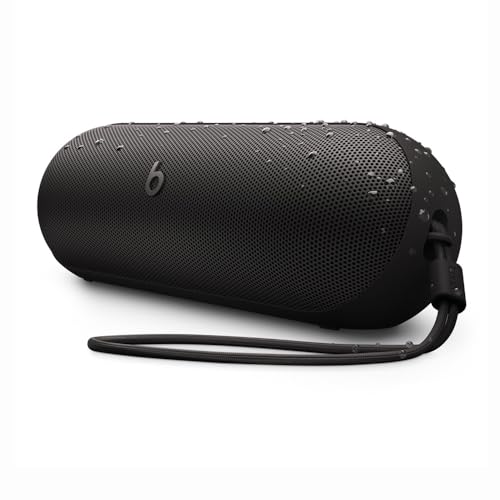
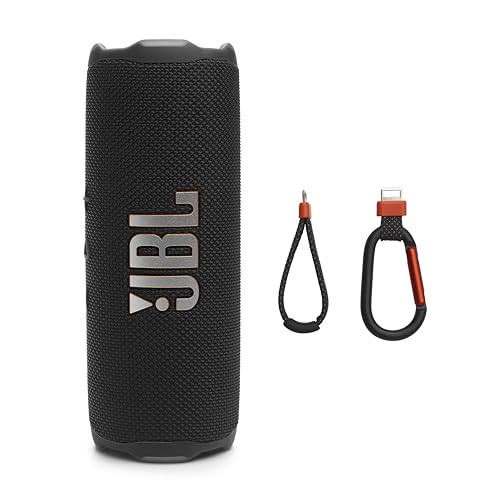
- Match the size to the spot. Beats lists the Pill at 24 oz (680 g) and 8.6 by 2.8 by 2.8 inches, a long, thin shape. The Bose SoundLink Flex (2nd Gen) is flat and wide, about 2 by 3.6 by 7.9 inches and 1.3 lb according to Bose. The JBL Flip 7 is a cylinder measuring 7.2 by 2.7 by 2.8 inches and weighing roughly 1.23 lb, according to Notebookcheck. The JBL Charge 6 weighs 2.18 lb and measures about 9.0 by 3.9 by 3.7 inches, per JBL.
- Skip the very large speakers. The JBL Boombox 4 is about 13 lb and 20 inches wide, and the Sonos Move 2 is 6.61 lb. At those weights, a speaker that comes loose is a serious projectile, and neither suits a car.
- Set the volume, the music and the navigation voice before you start driving. Do not adjust the speaker or your phone while the car is moving.
Heat in a Parked Car
A closed car on a sunny day can get much hotter than the air outside, and lithium batteries do not like it. Here is what we could confirm. The Beats, Bose Flex, Bose Max, Sonos Move 2 and Marshall Middleton II pages we opened list no operating or storage temperature range at all. The only temperature on Bose’s pages is a footnote saying its battery figures were measured at 68 to 77°F (20 to 25°C), with the line that battery performance varies with environmental temperature.
So we cannot give you a safe number, and we will not invent one. The practical answer is to read the owner’s manual for the exact model, take the speaker with you when you park in the sun, and avoid leaving it in a closed car in summer or on a freezing night. A speaker that has sat in a hot cabin is best left to return to room temperature before you charge it.
Hands-Free Calls and the Law
If you want calls through the speaker, you need a microphone. Per the makers’ own pages, the Beats Pill and the Bose SoundLink Flex (2nd Gen) have one. Beats says you can take calls and activate your voice assistant from the Pill, and it has a center button for call controls. Bose lists a built-in microphone for the Flex (2nd Gen) and multipoint, which keeps two paired devices connected at once. The JBL Flip 7 does not list a microphone on the pages we opened, and SoundGuys states the Charge 6 has none, so both are music-only here. Neither maker publishes how well its microphone handles road noise, so expect a speakerphone to work better at a stop than at highway speed.
A few ground rules:
- Never handle your phone while driving. Start calls and music before you move, or let a passenger do it.
- Hands-free laws vary by state. GHSA says 33 states and D.C. prohibit handheld phone use for all drivers, and that all but Alabama and Missouri enforce it as a primary offense. IIHS counts 32 states and D.C., so the figure depends on the page date. Some states have extra rules for new drivers, and GHSA lists broader bans for novice drivers in 36 states and D.C.
- Hands-free is not the same as safe. NTSB says “Hands-free is not risk free,” because drivers are still distracted by the conversation. A speakerphone only helps with the law, not with attention.
Check your state’s rules and your own comfort level before you rely on calls while driving. If a call needs your attention, pull over somewhere safe.
USB-C Charging in the Car
Most of the speakers here charge over USB-C. A USB-C car charger or a power bank in the center console keeps one topped up, and a few speakers can charge your phone back. Beats says the Pill can charge a phone over USB-C, and lists a 10-minute charge for up to 2 hours of playback, so a short drive adds real time. Bose says the Flex (2nd Gen) takes 4 hours from empty on a 5V/1.5A (7.5W) supply and does not include a power adapter. What Hi-Fi says the JBL Flip 7 ships without a USB-C cable, and JBL lists a full charge in about 2.5 hours. Keep a USB-C cable in the car either way.
Our Picks for a Car
Beats Pill: Calls and USB-C Charging
An entry-level speaker with call controls, a USB-C port that can charge your phone, and up to 24 hours of battery per Beats. Long and thin, so it is easier to wedge in than a wide speaker.
The Pill is the one we would start with for a car. It lists calls on the speaker, USB-C lossless audio and phone charging, and it works with Find My on iPhone and Find My Device on Android, which helps if you leave it on a seat. Beats does not say how many microphones it has or whether it reduces noise, and it publishes no Bluetooth version or codec list. Read our Beats Pill profile for the full specs.
Bose SoundLink Flex (2nd Gen): Small, With Multipoint
An entry-level speaker with a built-in microphone, multipoint and a floor-hugging shape. Bose lists up to 12 hours of battery, so plan to top it up.
The Flex (2nd Gen) suits shorter drives and mixed use. Bose lists IP67, Bluetooth 5.3 with a 30-foot range, and PositionIQ, which adjusts the sound to how the speaker is placed. Multipoint means it can stay linked to two paired devices, handy if two people share a car. The shortest battery of the three is the trade-off. See the Bose SoundLink Flex (2nd Gen) profile.
JBL Flip 7: Music Only, Easy to Place
An entry-level, music-only speaker with IP68 and a compact cylinder shape. JBL's page lists no microphone, so it is not a speakerphone.
If you only want music and navigation voice prompts, the Flip 7 is the smallest and lightest of the picks. JBL lists about 14 hours of playtime with Playtime Boost adding roughly 2, and IP68 with a 3.3-foot (1-meter) drop rating. Do not buy it for calls. It also cannot pair with older JBL speakers such as the Flip 6, according to What Hi-Fi. Our JBL Flip 7 profile covers it in detail.
JBL Charge 6: More Power, Still Music Only
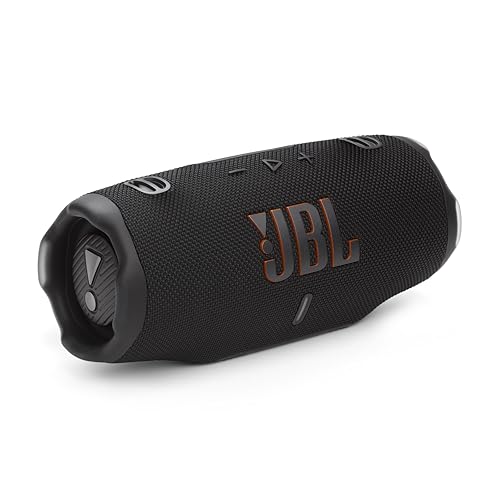
A mid-range, music-only speaker with a built-in power bank and up to 28 hours of playtime per JBL. About 2.18 lb, so it needs a secure spot.
For more volume in a larger cabin, the JBL Charge 6 lists 30 W RMS for the woofer and 15 W RMS for the tweeter. SoundGuys says it has no microphone, so it is music only, and it is heavier than the Flip 7.
What to Pick
- You take calls: the Beats Pill, or the Bose SoundLink Flex (2nd Gen) if you want multipoint.
- Music and navigation only: the JBL Flip 7, or the Charge 6 for more power and a longer battery.
- Your car has an aux jack: try a cable first. It is the simplest fix and uses the car’s own speakers.
- Loud music in the car: local rules cover noise from vehicles. Fargo, North Dakota, for example, caps vehicle stereos at 80 dB measured at 25 feet, with fines of up to $1,000. Check your own city’s code.
Sources
- Beats Pill official product page
- Bose SoundLink Flex (2nd Gen) official product page
- Bose SoundLink Max official product page (battery test conditions)
- JBL Flip 7 official product page
- JBL Charge 6 official product page
- SoundGuys on the JBL Charge 6
- JBL Flip 7 launch coverage, Notebookcheck
- What Hi-Fi on the JBL Flip 7
- GHSA, distracted driving laws
- IIHS, cellphone use laws
- NTSB, distracted driving
- City of Fargo, noise
Frequently asked questions
Can I use a portable Bluetooth speaker as my car stereo?
Yes, as a stand-in. Pair it with your phone, set your music or navigation voice before you start driving, and place the speaker where it cannot slide or fall. It will not replace a factory system for volume or for steering-wheel controls, and it will not play through the car's own speakers unless you add a receiver or adapter.
Is it legal to take calls on a speaker in the car?
Hands-free laws vary by state. GHSA says 33 states and D.C. prohibit handheld phone use for all drivers, and IIHS counts 32 states and D.C., so the number depends on the date of the page. Check your state's rules. NTSB also says hands-free is not risk free, because the conversation itself can distract you.
Which of these speakers have a microphone for calls?
Per their makers' pages, the Beats Pill and the Bose SoundLink Flex (2nd Gen) have one. The JBL Flip 7 and JBL Charge 6 do not list a microphone, and SoundGuys states the Charge 6 has none, so treat both as music-only.
Can a portable speaker stay in a hot parked car?
We cannot give you a safe number. The Beats, Bose, Sonos and Marshall pages we opened list no operating or storage temperature range, and Bose rates its battery figures at 68 to 77°F. Check the owner's manual and take the speaker with you when you park in the sun.
How do I charge a speaker in the car?
Use a USB-C car charger or a power bank with a USB-C cable. Bose says the Flex (2nd Gen) takes 4 hours from empty on a 5V/1.5A (7.5W) supply and that no power adapter is included, and What Hi-Fi says the JBL Flip 7 ships without a USB-C cable.
Should I use an aux cable instead?
If your car has a 3.5 mm aux jack, a cable from the phone to the car stereo gives you the car's own speakers with no extra battery. A speaker makes sense when the car has no aux jack, no Bluetooth and no USB audio, or when you want sound you can carry out of the car.